
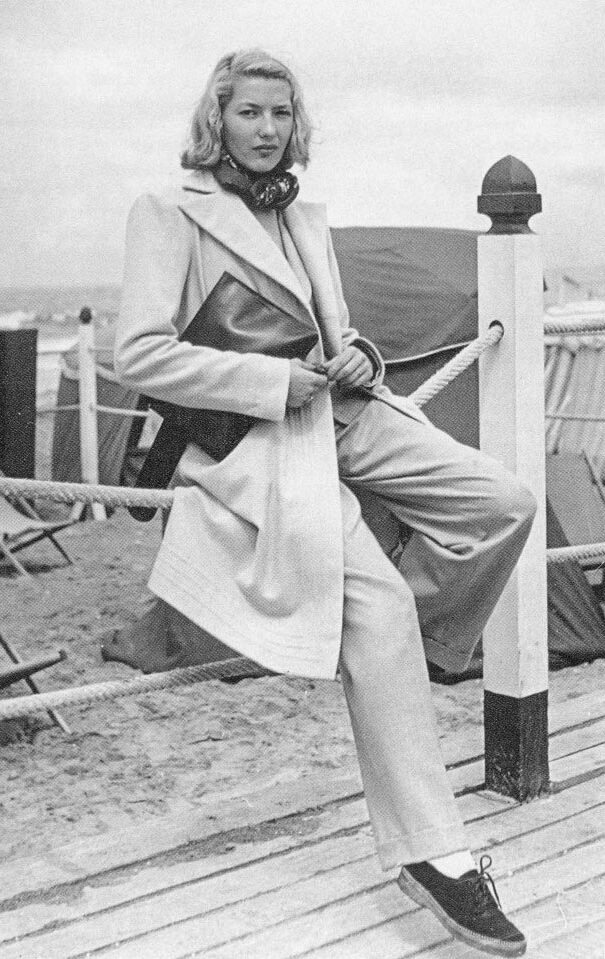
Corinne Luchaire
Personal
Body
About Corinne Luchaire
Corinne Luchaire, born February 11, 1921, was a French actress who rose to prominence in French films just before the outbreak of World War II. Her life became entangled with the German occupation, leading to a post-war sentence of "national indignity." After penning her memoirs, she succumbed to tuberculosis at the young age of 28.
Leaving her schooling behind, Luchaire joined Raymond Rouleau's drama program. Her stage debut occurred at sixteen under the name Rose Davel in a play penned by her grandfather, Altitude 3 200. The following year brought her a leading role in Prison sans barreaux, a film later remade in London in 1938 as Prison Without Bars, with Luchaire reprising her part. She possessed a fluent command of English. Esteemed actress Mary Pickford once hailed her as "the new Garbo." In 1939, she appeared in Le Dernier Tournant, the inaugural cinematic adaptation of the novel The Postman Always Rings Twice.
Born Rosita Christiane Yvette Luchaire in Paris, she was the daughter of Jean Luchaire, a journalist and politician who supported the Révolution nationale of the 1940 French Government. Her paternal grandfather, Julien Luchaire, was a playwright, while her maternal grandfather, Albert Besnard, was a painter. Her sister, Florence, also pursued an acting career. Her mother, a painter herself, was once the mistress of Gustav Stresemann, and it was with him that they relocated to Germany. Young Corinne captivated Stresemann's associate Kurt von Schröder, who permitted her to reside in his opulent mansion. Luchaire's formative years were spent in the company of Nazis who were frequent visitors to banker Schröder's home. It was there she met Otto Abetz, who would later become the German ambassador to Paris. Abetz married Suzanne, her father's secretary, who had previously been his mistress until 1939. In August 1940, Corinne accompanied her father to Vichy Paris.
Luchaire was briefly wed to a French aristocrat, Guy de Voisins-Lavernière. She emerged as a celebrated and spirited French actress, leveraging the political and social standing of her father, who edited the publications Les Temps Nouveaux and Toute la vie, during the Occupation. Despite frequent bouts of illness, including tuberculosis, which led her to cease acting in 1940, she was reported to have experienced the German occupation of Paris as a continuous series of champagne parties, receptions at the German Embassy, and German dinners at Maxim's.
Following D-Day in June 1944, Corinne embarked on a perilous train journey to Germany alongside other collaborationists. The journey was eventually thwarted by damaged railway lines, necessitating a transfer to vehicles bound for the Sigmaringen enclave.
Corinne Luchaire Photos






comment Responses (0)
Be the first to respond.